JillLebofsky may earn a commission if you buy through links on this page, at no extra cost to you. That does not change what we report.
Part of our Honey Burn overview. Last checked November 17, 2026.
Does Honey Burn work? We found no published trial of Honey Burn itself, so there is no direct evidence that it causes weight loss. Its best-studied ingredient, berberine, produced an average weight change of 0.88 kg across 23 trials of berberine taken alone.[4]
Honey Burn's label does not say how much berberine a serving holds.[1]
Does Honey Burn work? The short answer
Not in any way that can be checked. Some of its ingredients have small human trials on weight, blood sugar or blood pressure, but nothing shows that a 2 ml serving of this blend repeats those results.
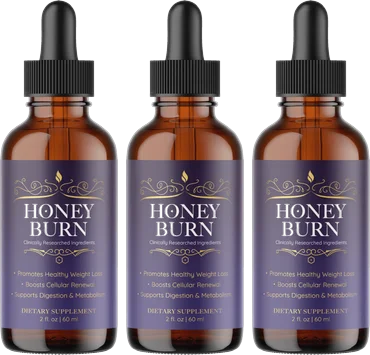
The vendor calls Honey Burn a purple weight loss honey that boosts lipase and says its formula is backed by clinical research.[2] We found no trial of the product, no lipase measurement in people taking it and no dose for any single ingredient. The label puts all 11 ingredients in a 550 mg Royal Honey Blend.[1]
The label also prints: WARNING: The safety of this product has not been determined. The sales page says the ingredients were shown to be safe in clinical trials. When the two disagree, trust the label.
Which evidence levels should you not confuse?
Four kinds of evidence get blended together on supplement sales pages. Only the third one would answer whether Honey Burn works, and it does not exist.
Plausibility: lab and animal work
The vendor's 22-item reference list relies on fat cells grown in dishes (3T3-L1 and porcine adipocytes), diabetic rats and mice fed high-fat diets.[3] It also cites papers unrelated to weight, such as touch in primary care consultations and supplements and cognition in military personnel. Lab work suggests a mechanism might exist and stops there.
Ingredient trials in people
Here people take one ingredient at a known dose. Berberine has many such trials, yet an overview of 54 systematic reviews rated 45 of them very low quality and found only 4 of 7 obesity outcomes improved.[6]
A trial of the finished product
A placebo-controlled trial of Honey Burn at the label dose would settle the question. We found none, and the sales page cites none.
Replication
One result needs a second team to repeat it. The kudzu flower weight trial in 81 adults has no replication,[7] and Honey Burn uses kudzu root in any case.
Honey Burn claims vs what the evidence supports
Each sales-page claim below is the vendor's wording, read November 17, 2026.[2] The middle column gives the fairest reading of the human data we hold; the right column shows why it does not carry over to the product.
| Vendor claim | Reasonable reading | Limitation |
|---|---|---|
| Boosts lipase levels | A theory drawn from lab and animal papers | No human lipase data for the product |
| Berberine speeds up fat metabolism | Small average weight loss in meta-analyses[4][5] | Dose not printed; listed last in the blend |
| Kudzu boosts lipase | Kudzu flower lowered visceral fat in one trial[7] | Label uses root; no root weight trial found |
| Sodium alginate and carrot help suppress hunger | Alginate cut intake at one test meal at gram doses[8] | Weight pilot was null;[9] the "carrot" is radish on the label |
| Holy basil and olive leaf regulate cholesterol and blood sugar | Olive leaf lowered blood pressure and triglycerides in 12 trials[10] | Holy basil has no weight trial[11] |
| Wild raspberry reduces fat accumulation | Fruit studied for post-meal blood sugar | No weight trial; label uses seed |
Which ingredients matter most?
Berberine and kudzu matter most, because they are the only two with weight-related human data. Both carry mismatches of dose, form and population.
Dose. The whole blend weighs 550 mg. Kudzu flower trials used 200 to 300 mg of flower extract alone,[7] and alginate studies used grams.[9] Eleven ingredients cannot each reach those amounts inside 550 mg.
Form. Kudzu root is not kudzu flower. Raspberry seed is not the fruit or leaf used in trials. The "purple carrot powder" on this label carries the Latin name Raphanus sativus, which is radish.[1]
Population. Berberine's blood sugar effect comes from trials in type 2 diabetes,[6] and the kudzu trial enrolled obese Japanese adults.[7] Results in those groups may not apply to other buyers. Our Honey Burn ingredients guide covers each item.
What results are realistic to expect?
Only small changes have been measured, and only for single ingredients at known doses. Berberine trials averaged 0.88 kg of weight loss.[4] Kudzu flower lowered BMI and visceral fat area over 12 weeks.[7] Olive leaf lowered systolic blood pressure by 3.86 mmHg.[10]
The sales page shows testimonials of 10 and 20 lb losses; these are unverified vendor claims. The vendor also asks buyers to try it for at least 3 months, longer than its 60-day refund window.[12] If you are on the fence about belly fat claims in particular, read that page first.
When should you see a doctor instead?
See a doctor before buying any fat burner if weight is changing without a reason you know, or if you have diabetes, liver disease or a heart condition. See a doctor right away if, after taking Honey Burn, you have:
- dark urine, yellow skin or eyes, or pain in the upper right belly (liver warning signs on our kudzu evidence card)
- hives, swelling of the lips or throat, wheezing or trouble breathing
- shakiness, sweating or confusion while taking diabetes medicine
- severe or lasting stomach pain, vomiting or diarrhea
Our Honey Burn side effects page lists the medicines worth checking with a pharmacist.
Evidence conclusion
Honey Burn has not been shown to work for weight loss. The table gives our assessment of each question a buyer should ask, as of our check on November 17, 2026.
| Decision question | Our assessment |
|---|---|
| Is there a trial of Honey Burn? | None found |
| Are ingredient doses printed? | No, all 11 sit in a 550 mg proprietary blend |
| Strongest ingredient evidence | Berberine: small average weight loss, low-quality reviews |
| What the label says about safety | Safety has not been determined |
| Refund terms | 60 days; all bottles returned at the buyer's cost |
If you buy, use the vendor site, check the label on the bottle you receive and see Honey Burn prices before choosing a bundle.
Back to the Honey Burn overview.
Frequently asked questions
Is Honey Burn clinically tested?
We found no published clinical trial of Honey Burn as a finished product. The vendor reference list cites lab, animal and single-ingredient studies, plus papers unrelated to weight, none of which tested this 2 ml honey blend in people.
How much weight can you lose with Honey Burn?
No figure exists for the product. Berberine alone averaged 0.88 kg of weight loss across 23 trials, and the sales page testimonials of 10 and 20 lb losses are unverified vendor claims with no way to check them.
Does Honey Burn boost lipase?
That is the vendor's claim. We found no study measuring lipase in people taking Honey Burn. The idea rests on lab work with fat cells and on animal studies, which cannot show what a 2 ml dropper does in a person.
Is purple weight loss honey real?
Purple weight loss honey is the vendor's marketing name for Honey Burn, a liquid blend of honey, bee products and plant extracts. The label lists natural flavors and colors; we found no study linking honey color to weight.
Do honey weight loss drops work better than capsules?
No study compares them for this product. The form does not fix the core problem: Honey Burn prints no ingredient amounts, so neither drops nor capsules of this formula can be matched to trial doses.
Sources
- Honey Burn label and Supplement Facts (image). HoneyBurn, read November 17, 2026.
- Honey Burn sales page. HoneyBurn via BuyGoods, read November 17, 2026.
- Honey Burn references page. HoneyBurn, read November 17, 2026.
- Berberine and body weight: meta-analysis of 23 randomized trials (PMID 41310257). PubMed, read October 19, 2026.
- Berberine and weight, BMI and waist: meta-analysis of 12 randomized trials (PMID 32690176). PubMed, read October 19, 2026.
- Berberine: overview of 54 systematic reviews (PMID 40269802). PubMed, read October 19, 2026.
- Pueraria thomsonii flower extract and visceral fat in obese Japanese adults (PMID 22878195). PubMed, read November 17, 2026.
- Alginate-enriched cookies and energy intake: crossover study (PMID 22850326). PubMed, read October 26, 2026.
- Alginate preloads during calorie restriction: 2-week pilot trial (PMID 21777634). PubMed, read October 26, 2026.
- Olive leaf extract and cardiometabolic markers: meta-analysis of 12 randomized trials (PMID 36271405). PubMed, read October 27, 2026.
- Tulsi (holy basil): systematic review of 24 human studies (PMID 28400848). PubMed, read October 19, 2026.
- Honey Burn refund policy. HoneyBurn, read November 17, 2026.
This page is general information, not medical advice. Dietary supplements are not reviewed by the FDA for safety or effectiveness before they are sold and are not intended to diagnose, treat, cure or prevent any disease. Talk to your doctor before taking any supplement, especially if you are pregnant, nursing, take medication or have a health condition.